

I previously explained how to get one-minute resolution in Munin. The process to get sub-minute resolution in Munin is more tricky. The main reason it’s more tricky is that cron only runs once per minute, which means data must be generated and cached in between cron runs for collection when cron runs. In the case where a single datapoint is collected each time cron runs, the time at which cron runs is sufficient to store the data in rrd. With multiple datapoints being collected on a single cron run, it’s necessary to embed......
Continue Reading
I’ve recently been conducting some performance testing of a PaaS solution. In an effot to capture specific details resulting from these performance tests and how the test systems hold up under load, I looked into a few monitoring tools. Munin caught my eye as being easy to setup and having a large set of data available out of the box. The plugin architecture also made it attractive. One major drawback to Munin was the five minute resolution. During performance tests, it’s necessary to capture data much more frequently. With the latest Munin, it’s......
Continue Reading

Munin is a monitoring tool which captures and graphs system data, such as CPU utilization, load and I/O. Munin is designed so that all data is collected by plugins. This means that every built in graph is a plugin that was included with the Munin distribution. Each plugin adheres to the interface (not a literal OO inteface), as shown below. Munin uses Round Robin Database files (.rrd) to store captured data. The default time configuration in Munin collects data in five minute increments. Some important details: Plugins can be written in any language,......
Continue Reading
This post is an extension of Managed services in CloudFoundry and follows the discussion of external services integration. The echo service and python service broker implementation are deployed using the documented procedure for Stackato. If necessary, you can get a Stackato instance up and running quickly. The result should be two apps deployed as shown below. Optional validation It is possible to validate that the deployed apps work as expected. The curl commands below validate the echo service is working properly. watrous@watrous-helion:~$ curl -X PUT http://echo-service.stackato.danielwatrous.com/echo/51897770-560b-11e4-b75a-9ad2017223a9 -w "\n" {"instance_id": "51897770-560b-11e4-b75a-9ad2017223a9", "dashboard_url": "http://localhost:8090/dashboard/51897770-560b-11e4-b75a-9ad2017223a9", "state":......
Continue Reading
This post builds on the discussion of Managed Services in CloudFoundry and covers the first of the two methods for using unmanaged services in CloudFoundry. It makes use of the Python echo service and Python service broker API implementation used previously. Manually provision the service This method assumes that an existing service has been provisioned outside of CloudFoundry. An instance of the echo service can be manually provisioned using cURL using the following commands. In this example, a new instance is provisioned with the id user-service-instance and bound to an app with id......
Continue Reading
CloudFoundry defines a Service Broker API which can be implemented and added to a CloudFoundry installation to provide managed services for apps. In order to better understand the way managed services are created and integrated with CloudFoundry (and derivative technologies like Stackato and HP Helion Development Platform), I created an example service and implemented the Service Broker API to manage it. The code for both implementations are on github. https://github.com/dwatrous/cf-echo-service https://github.com/dwatrous/cf-service-broker-python Deploy the services For this exercise I deployed bosh-lite on my Windows 7 laptop. I then follow the documented procedure to push......
Continue Reading
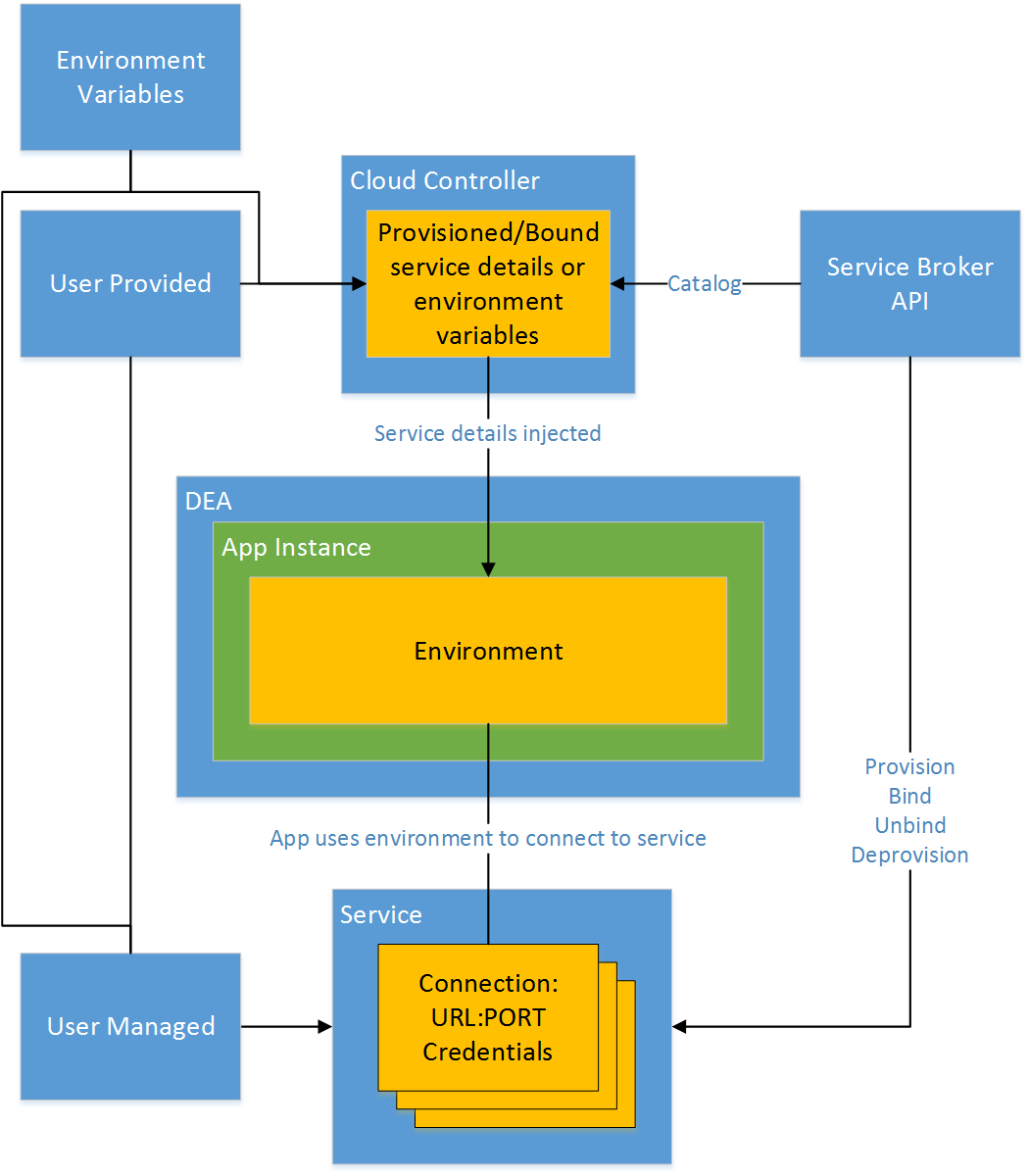
CloudFoundry, Stackato and Helion Development Platform accommodate (and encourage) external services for persistent application needs. The types of services include relational databases, like MySQL or PostgreSQL, NoSQL datastores, like MongoDB, messaging services like RabbitMQ and even cache technologies like Redis and Memcached. In each case, connection details, such as a URL, PORT and credentials, are maintained by the cloud controller and injected into the environment of new application instances. Injection It’s important to understand that regardless of how the cloud controller receives details about the service, the process of getting those details to......
Continue Reading

I have observed that discussions about CloudFoundry often lack accurate context. Some questions I get that indicate context is missing include: What Java version does CloudFoundry support? What database products/versions are available How can I access the server directly? There are a few reasons that the questions above are not relevant for CloudFoundry (or any modern PaaS environment). To understand why, it’s important to understand how we got to PaaS and where we came from. Landscape When computers were first becoming a common requirement for the enterprise, most applications were monolithic. All applicaiton......
Continue Reading
It’s possible to add a custom buildpack to Stackato or Helion Development Platform so that it’s available to all applications. When using an installed buildpack it is not necessary to include a manifest or identify the buildpack. Instead it will be selected by the detect script in the buildpack. All files are on the cloud controller node which eliminates download time and bandwidth. Package the buildpack Prepare your buildpack for installation by adding all files to a zip file (of any name). The bin folder should be in the root of the zip......
Continue Reading
In the past PaaS has been rigid and invasive for application developers. CloudFoundry aims to change that perception of PaaS with the use of Buildpacks. A Buildpack allows an application developer to define his deployment environment in plain text. Some refer to this as infrastructure as code since the aspects of a deployment environment that were previously handled by system administrators on dedicated servers now exist in plain text alongside the application files. What’s available out-of-the-box? Before diving into custom buildpacks, a lot of people will ask “What is available out-of-the-box with CloudFoundry?”.......
Continue Reading